
Among the most highly revered of all the Shinto Kami is Amaterasu Omikami, the Great Sun Goddess. Amaterasu Omikami is virtually the supreme deity in Japanese mythology as well as the ancestor goddess of the imperial family.
In order to understand why Amaterasu Omikami is the object of such devotion, one must examine her origins. There are several versions of this creation story. The Nihongi, an eighth-century collation of many ancient Japanese myths and legends, records that the two creator deities, Izanagi no Mikoto ("The Male Who Invites") and Izanami no Mikoto ("The Female Who Invites"), first descended from heaven and together produced the various islands of Japan, together with the mountains, rivers, and surrounding seas.
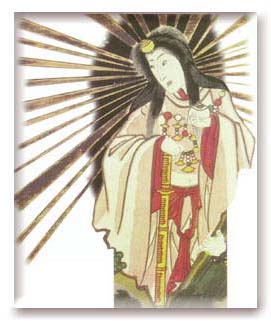
Then they undertook their greatest work of all, to generate the high Kami that would rule over all these dominions. First they procreated Amaterasu Omikami, whose radiance shone through the six directions. The divine parents were so delighted with this child that they immediately sent her up to heaven and established her there to rule over all she could survey.
Next, Izanami and Izanagi created Tsukiyomi no Mikoto, the Moon Kami, whom they also set in heaven and designated as Amaterasu's celestial consort.
Third, the creator gods generated a "Leech Child", which appeared so bungled and misshapen that they regretfully put it in a boat and abandoned it to the winds. Fourth, they procreated Susano-O no Mikoto, the Storm Kami.
Another version of Amaterasu and her siblings' genesis is also recounted in the Nihongi. This myth names Izanagi alone as their divine progenitor.
A third version of the Sun Goddess's origin occurs in the Kojiki (712 C.E.), the oldest extant source of Japanese mythology. This rendition of the story places it in a much more somber context involving death, purification, and rebirth.
Relations between Amaterasu and her youngest brother Susano-O were rocky from the beginning. Susano-O constantly upset his elder sister with reckless behavior and destructive acts.
Eventually, after one especially violent outburst involving the destruction of Amaterasu's weaving hall, the Sun Goddess hid herself within the Rock Cave of Heaven, plunging the world into darkness.
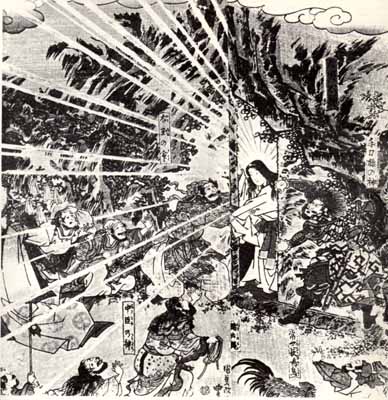
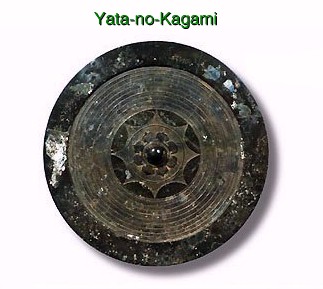
The absence of light prompted eight-hundred deities to gather around the cave and devise a plan to lure her out. They crafted the sacred mirror Yata no Kagami and the curved jewels Yasakani no Magatama.

Meanwhile, the goddess Ame no Uzume performed a wild dance that caused the assembled gods to roar with laughter. Curious about the noise, Amaterasu slowly opened the cave door.
Seeing her own reflection in the mirror and hearing the joyful sounds outside, she emerged from hiding. At that moment the deity Ama no Tajikara-wo no Kami pulled her fully from the cave and prevented her from retreating back inside.
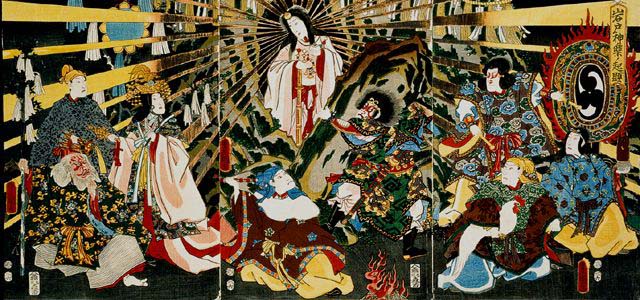
Amaterasu agreed to remain in the visible world, restoring light to heaven and earth. Susano-O, however, was punished and exiled from heaven.
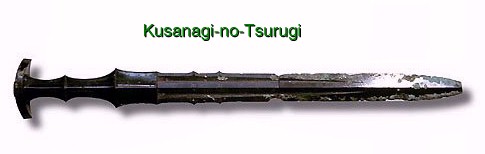
Later, after defeating the Orochi Dragon, Susano-O discovered the legendary sword Kusanagi no Tsurugi and offered it to Amaterasu in reconciliation.
Amaterasu also played a central role in establishing divine rule over the terrestrial world through her descendants, especially Ninigi no Mikoto.
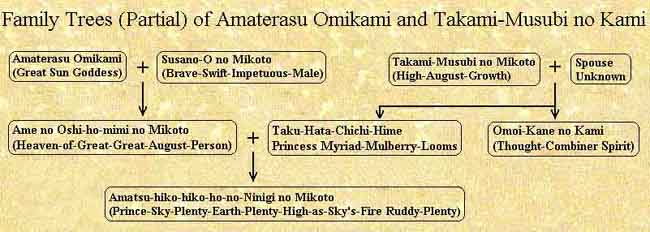
Before sending Ninigi to earth, Amaterasu entrusted him with the Three Sacred Regalia: the mirror Yata no Kagami, the jewel Yasakani no Magatama, and the sword Kusanagi no Tsurugi.
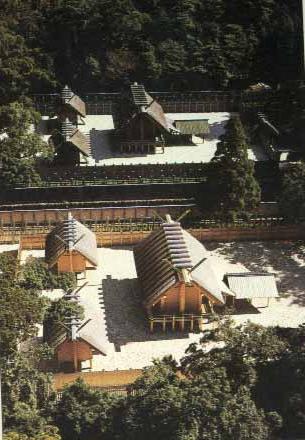
In approximately the fourth century C.E., during the reign of Emperor Suinin, the cult of Amaterasu came to Isé and an especially sacred shrine was dedicated in the goddess's honor.
Following longstanding Shinto tradition, the Inner Shrine at Isé has been rebuilt every twenty years since the 690s. This reflects the Shinto emphasis on purity and renewal.
Within the shrine are located the sacred mirror and heavenly arrows. Pilgrimage to the shrine remains one of the most important acts of devotion in Shinto practice.
Worship of the Sun Goddess, Amaterasu, has survived for thousands of years in the heart of Japan. She remains one of the most revered figures in Japanese spiritual tradition.
Sources
Collcutt, Martin; Jansen, Marius; and Kumakura, Isao. Cultural Atlas of Japan.
Encyclopedia of Religion, Eliade, Mircea, and Adams, Charles J.
Guirand, Felix, ed. New Larousse Encyclopedia of Mythology.
Kojiki: Records of Ancient Matters (712 C.E.).
Kitagawa, Joseph M. Religion in Japanese History.
Nihongi: Chronicles of Japan.
Tsunoda, Ryusaku; de Bary, William Theodore; and Keene, Donald.