Ame-no-Uzume no Mikoto
Ame-no-Uzume no Mikoto, “the Terrible Female of Heaven,” is an important Kami in Japanese mythology and is also regarded as the founding ancestor of the Sarume Order. Although she is mentioned but a few times in the chapters of the Kojiki (Record of Ancient Matters, c. 712 C.E.), she assumes a prominent role in each story in which she appears.
The first mention of Ame-no-Uzume is in the story of Amaterasu Omikami, the Sun Goddess, shutting herself into the rock cave in the 17th chapter of the Kojiki. In order to ensure Amaterasu’s return, the other Kami consulted and worked together to entice her out of hiding.
Some Kami prepared to lure her out with beautiful glittering objects which they hung upon the sacred Sakaki tree; while others were ready to prevent the cave door from closing again after she opened it; but all of those plans centered on Uzume.
To her fell the task of getting Amaterasu to open her door in the first place. To this end she disrobed and proceeded to perform a lewd and comical dance on an overturned tub. The other Kami joined in with boistrous singing and laughing. The ensuing noise and general carrying-on got Amaterasu to peek out after from the cave, which made it possible for the other Kami to get her to come out and stay (Kojiki 81-85).
Another ancient source, the Nihongi (Chronicles of Japan, 720 CE), offers a slightly different description of Ame-no-Uzume's dance.
Moreover Ama no Uzume no Mikoto, ancestress of the Sarume no Kimi, took in her hand a spear wreathed with Eulalia grass, and standing before the door of the Rock-cave of Heaven, skillfully performed a mimic dance...
In both versions, it was as a result of Uzume's wild singing and dancing that Amaterasu emerged from her cave. Thus, the beautiful and life-giving sunlight returned to the world, thanks in large part to Uzume's performance.
Later, Ame-no-Uzume again played a significant role in myths concerning the descent of Ninigi no Mikoto, the August Grandchild of Heaven.
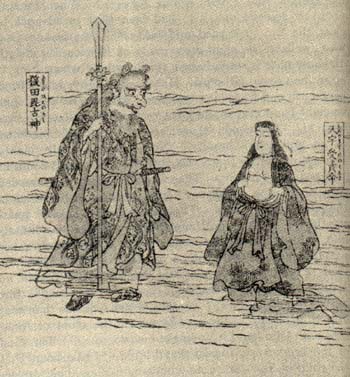
When Ninigi was about to descend, a frightening earthly deity appeared to block the intended path. This was an immense creature, with a back extending seven fathoms, a nose the size of seven hand lengths, a colossal mouth, and eyes glowing like fire.
Ninigi sent Uzume on ahead to investigate this leviathan, charging her to use the daunting power of her looks to question and subdue him. The fearless goddess accordingly descended and went to Saruta-Hiko:
Ame-no-Uzume forthwith bared her breasts and, pushing down the band of her garment below her navel, confronted him with a mocking laugh...
Thus, it turned out that Saruta-Hiko was not an enemy after all, but would prove to be a valuable guide and aid to Ninigi.
Uzume was subsequently accorded great honors by Ninigi. Through his authority, she was made the founder and head of the Sarume Order of sacred festival dancers.
The final episode involving Ame-no-Uzume in the Kojiki occurred immediately after she returned from accompanying Saruta-Hiko.
Ame-no-Uzume-no-Mikoto is by no means the most important Kami in the stories and traditions of Shinto. Yet she is greatly honored for her efforts to get Amaterasu to return from her self-imposed exile in the rock cave.
The inspired dance that she performed on that occasion is still celebrated in various types of Kagura Festivals, which play a special role in the Shinto religion.
Ame-no-Uzume is also appreciated for her participation in Ninigi's successful efforts to establish the rule of Heaven on Earth.
In the opinion of this writer, learning about the mythical exploits of Ame-no-Uzume no Mikoto can help one to appreciate the ancient Japanese people's adventurous spirit, keen sense of humor, and respect for the mysterious power of the female.
Sources
Bocking, Brian. A Popular Dictionary of Shinto. Lincolnwood, Illinois: NTC Publishing Group, 1995.
Kitagawa, Joseph M. Religion in Japanese History. New York: Columbia University Press, 1966.
Kojiki. Translated by Donald L. Philippi. Tokyo: University of Tokyo Press, 1968.
Nihongi: Chronicles of Japan from the Earliest Times to A.D. 697. Translated by W.G. Aston. London: George Allen & Unwin, 1956.