Ninigi no Mikoto
Ninigi no Mikoto -- his full name was Amatsu-hiko-hiko Ho-no-Ninigi no Mikoto, meaning "Prince Sky-Plenty-Earth-Plenty-High-as-Sky-Ruddy-Rice-Ear-Plenty" -- was the August Grandchild of three of the greatest Kami in the Shinto pantheon: Amaterasu Omikami, Susuno-O no Mikoto, and Takami-Musubi no Mikoto. Ninigi's ancestry, representing the fusion of such illustrious lines of divine descent, endowed him with immense power and wisdom.
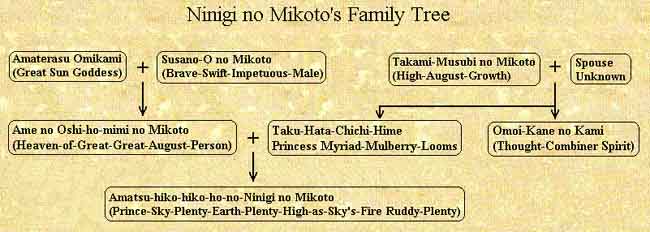
Ninigi was sent to earth by Amaterasu and Takami-Musubi because they and the other heavenly Kami were displeased with the behavior of the terrestrial Kami below. There had been far too much dissension and insubordination in the world. The August Grandchild's duties were to restore order and to rule the land.
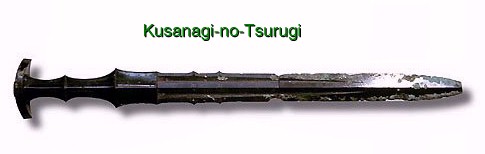
Before he departed, Amaterasu gave him a divine mandate, telling him "the Luxuriant Reed Plains, the Land of Fresh Rice Ears and Fifteen Hundred Autumns (i.e., Japan), is a land that shall be ruled by my descendants. Go there and rule. Go, and may your line prosper eternally, like heaven and earth." Then she bestowed on Ninigi the Imperial Regalia (consisting of the sacred Yata no Kagami, or Eight-Handed Mirror, the curved Yasakani no Magatama Jewel, and the Sword Kusanagi no Tsurugi).
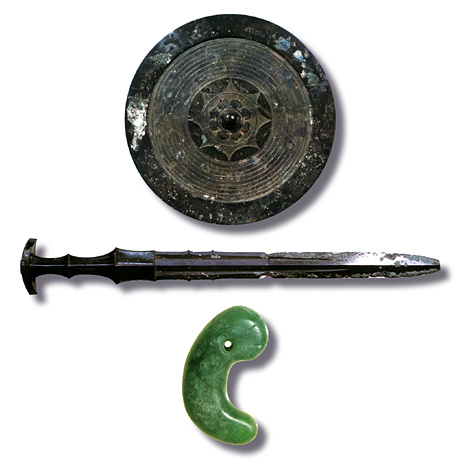
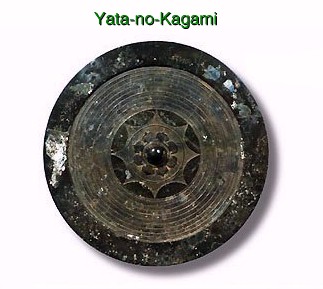

This mirror had been the very one that the heavenly Kami had used to entice Amaterasu out of her rock cave, thus restoring light to the world. The Yasakani Jewel was among those that had hung on the sacred sakaki tree that the Kami had placed in front of the rock cave for the same purpose.
And the Sword Kusanagi was the one that Susano-O had retrieved from the tail of the Orochi dragon and later presented to his August Sister. Therefore these Imperial Regalia would serve forever as charismatic symbols of divine authority, and Amaterasu conferred them on Ninigi with due solemnity.
She said, "Whenever you look upon this mirror, may it be as though you are looking upon me. Keep it with you as your sacred mirror, in your bed and under your roof." She also told him, "As the mirror is bright, illuminate the world; as the jewels spread broadly, rule with their wonderful sway; and with the sword, subdue all those who do not submit to your rule" (Kitabatake 76).
Amaterasu sent eight million deities to go with Ninigi. These are the spirits that would infuse all of nature, all cultural artifacts, as well as all intellectual attainments.
Thirty-two of these deities were leaders; and five were especially important:
- Ame-no-Koyane no Mikoto (Sky-Beckoning-Ancestor Lord), who had helped to lure Amaterasu from her rock cave by reciting prayers, and who was destined to found a long line of Shinto high priests and shamans;
- Ame-no-Futodama no Mikoto (Sky-Great-Jewel Lord), who had contributed to Amaterasu's return by bringing forward the sacred sakaki tree, and who was to become the ancestor of another line of high priests;
- Ame-no-Uzume no Mikoto (Sky-Frightening-Female), whose lewd and comical dance had first summoned Amaterasu from the rock cave, and who was to become the patroness of the annual kagari festivals;
- Ishi-Kori-Dome no Mikoto (Master of Mirrors), who had fashioned the sacred Yata Mirror and became the founder of a family of imperial mirror-makers;
- Tamaya no Mikoto (Jewel-Ancestor), who had made the sacred Yasakani Jewels and was to establish a succession of imperial jewel-makers.
Accompanied by this great train of attendants, Ninigi no Mikoto landed on Mt. Takachiho in Kyushu and proceeded to build a palace on the Cape of Kasasa (Larousse 412). Soon he met O-Kuni-Nushi no Mikoto, who was headquartered in Izumo and already held sway in Japan.
At first the latter was reluctant to give up his rule, but he submitted when Ninigi gave him the right to control private and family affairs. Ninigi and his descendants, in turn, would control political and public affairs. On reaching this agreement, Ninigi proceeded to Is� and built a second palace on the Cape of Nagasa (Kitabatake 78).
Next on the agenda was to find himself a worthy wife. Ninigi summoned two divine sisters in order to choose between them.
The elder sister, Ihanaga-Hime, was a rock deity, blessed with great strength and longevity. The younger sister, Kono Hana no Saku-ya-Hime (Princess Tree-of-Flower-Blossom), was the spirit of Mt. Fuji and the deity of flowers and trees.
Ninigi found the latter much more attractive, and so he chose her for his wife. Ihanaga-hime then cursed Ninigi, saying, "If you had selected me, the lives of people would have been long, like rocks. Instead, you picked my sister, and so their lives will wither and die like blossoms on the trees" (Nihongi 84-85, Kitabateke 78-79).
This is the Shinto reason for why human lives are so short. Up to this point, the lives of humans had been extremely long -- lasting thousands of years! The fragility of human life is a motif that would later come to be expressed in the poignant phrase mono no aware, the pathos of things -- a key concept in Japanese culture.
After they got married, Kono Hana conceived on the first night. Ninigi became suspicious at this, accusing his new wife of infidelity.
She was so incensed that she enclosed herself in a hut and set fire to it, saying "May my children live only if they are truly those of my lord and husband!"
Miraculously, she gave birth to three children: Honosusori no Mikoto (Fire-Glow), Hoakari no Mikoto (Fire-Climax), and Hiko-hoho-demi no Mikoto (Fire-Fade) (Wheeler 80, Kitabatake 79).
All was forgiven then, and the divine couple shared many blissful years together. Two of their children, Honosusori and Hiko-hoho-demi, became the deities of fishing and hunting, respectively.
They are involved in another famous myth, which involves the two brothers switching fishing gear for bow and arrow.
Hiko-hoho-demi later became the grandfather of Jimmu, considered to be the first emperor of Japan.
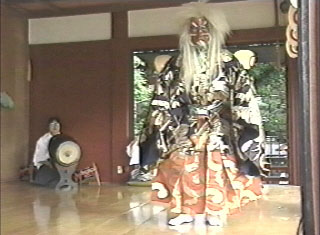
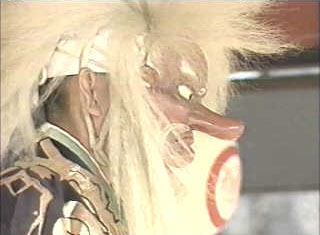
According to legend, Ninigi ruled Japan for 308,533 years (Kitabatake 79). His exploits are still regularly celebrated at sato-kagura performances, local festivals ritually enacting scenes from Shinto mythology.
The two scenes shown here represent Ninigi following his enthronement, while he is engaged in arranging happy marriages for his loyal vassals.
Sources
Guirand, Felix, Ed. New Larousse Encyclopedia of Mythology. Prometheus Press, 1972.
Kitabatake, Chikafusa. Jinno Shotoki (A Chronicle of Gods and Sovereigns). Translated by H. Paul Varley. New York: Columbia University Press, 1980.
Malm, William P.; Brown, Sidney D.; and Enrico, Eugene. Shinto Festival Music [Videorecording]. Norman, Okla.: University of Oklahoma, Center for Music Television, c1993.
Nihongi (Chronicles of Japan from the Earliest Times to A.D. 697). Translated by W.G. Aston. London: George Allen & Unwin, 1956.
Tsunoda, Ryusaku; de Bary, William Theodore; and Keene, Donald, Eds. Sources of Japanese Tradition. New York: Columbia University Press, 1958.
Wheeler, Post. The Sacred Scriptures of the Japanese. New York: Henry Schuman, Inc., 1952.