Tsukiyomi no Mikoto
The Shinto Moon Kami
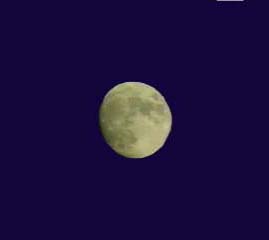
In ancient Shinto mythology, Tsukiyomi no Mikoto is the Moon Kami. “Tsuki” means moon and “yomi” means darkness or night. Hence “Tsukiyomi no Mikoto” can be translated as “His Augustness Moon-Night-Possessor.” This deity appears in two important myths, the creation myth and a curious narrative about the death of the Food Kami.
According to one of the earliest Japanese texts, the Nihongi (C.E. 720), the original Creator Gods in heaven produced several successive generations of celestial Kami, including the pair Izanagi no Mikoto and Izanami no Mikoto . The latter deities, a brother and sister, received from their superiors the sacred mandate to descend from heaven to the terrestrial world, where they were to generate and form an entire new realm of beings.
Izanagi (“The Male Who Invites”), together with his sister-bride Izanami (“The Female Who Invites”), passed down the floating bridge of heaven and undertook to create a universe by engaging in multiple divine acts of sexual reproduction. The Nihongi, itself a collation of several still older texts, records some alternative versions of how Tsukiyomi no Mikoto came into being.
One version states that the two high gods, after having created the islands of Japan with their plentiful mountains, rivers, and lush plant life, consulted together and decided that this new realm required a set of rulers to preside over it.
Accordingly, they then created Amaterasu Omikami (the Sun Goddess) and her younger brother Tsukiyomi, assigning the former to oversee the day and the latter to supervise the night.
The Kojiki, dating from 712 C.E. and therefore a few years older still than the Nihongi, offers a fascinating variant of the ancient myth.
This text places the creation of the sun and moon considerably after the death of Izanami, who had perished in the process of giving birth to Kagutsuchi, the Fire God.
After these painful events, Izanagi, realizing that he had been polluted by his contact with death, decided to purify himself through bathing. Amaterasu Omikami emerged while he was washing his left eye, and Tsukiyomi no Mikoto while washing his right eye.
A third deity, Susano-O no Mikoto, sprang from Izanagi’s cleansing of his nose during this ritual purification.
After these events, Tsukiyomi does not reappear in the Kojiki. In the Nihongi, however, the Moon God is mentioned again regarding the death of the Food Kami, Uke-Mochi no Kami.
The myth states that Amaterasu asked her brother, Tsukiyomi no Mikoto, to go and speak with Uke-Mochi no Kami. When Tsukiyomi no Mikoto arrived to speak with her, Uke-Mochi no Kami offered him food she had produced from her own mouth as refreshment.
Tsukiyomi no Mikoto was angered and disgusted by this offer. “Filthy! Nasty!” he said, “That thou shouldst dare to feed me with things disgorged from thy mouth.”
After telling Uke-Mochi no Kami she was impure for doing this, Tsukiyomi no Mikoto slew her with his sword.
Upon his return to the heavens, Amaterasu learned of his actions and was angry with him. From then onward, the Sun Goddess and Moon God remained separated, explaining the division between the two heavenly bodies.
It is interesting to reflect that Tsukiyomi was apparently too fixated on the dangers of pollution to be practical. Amaterasu, on the other hand, realized the vital truth that all life proceeds by a kind of recycling.
Night is also the time of restoration through sleep and dreams. Tsukiyomi no Mikoto, ruler of the night, is represented in the Nihongi as clad in mystical garments of gorgeous colors.
Some scholars speculate that the Kami Tsukiyomi no Mikoto and Amaterasu were conceived as a pair because people thought of them as “eyes in the sky,” watching their actions at all times.
For hundreds of years, Tsukiyomi no Mikoto has been worshipped at the shrines in Isé, whose primary deity is Amaterasu.
The shrine stands on a mountain called Gassan, which means Mountain of the Moon, and is a famous site for religious pilgrimages.