Susano-O no Mikoto
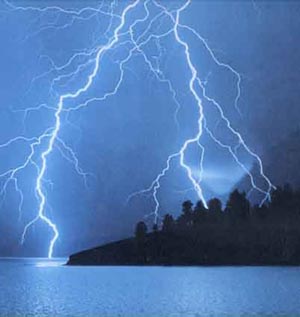
According to the ancient religion of Shinto, Susano-O no Mikoto, the Brave-Swift-Impetuous-Male, is the god of the storms and of the sea. He is a Kami with a highly volatile temper, who is very often impulsive, but yet he also has a kind and generous side.
In the religion of Shinto, Kami may have multifaceted personalities. Susano-O is a prime example. The Kami's four spirits or "tama" cause him to behave in many different ways.
Susano-O's Ara-mi-tama (Rough Spirit) is very evident in the story of his birth and in his dealings with his sister, Amaterasu Omikami. Both Susano-O and Amaterasu are the offspring of the creators of the earth, Izanagi and Izanami .
Susano-O came into being as Izanagi, the Male Who Invites, was purifying himself by cleansing away the impurities that he had acquired in the process of attempting to reclaim Izanami, the Female Who Invites, from the underworld. Susano-O was born as his father was washing his August nose.
As soon as Susano-O came into existence, he immediately began wailing and lamenting for his mother. This wailing and lamenting already expressed the Kami's stormy character. His father tried to calm him, but his wails eventually became too much for everyone around to bear, so he was banished to the netherworld.
Susano-O decided that before he left on his journey to the underworld, he wanted to wish his sister Amaterasu farewell. However, his coming shook the ground and made so much noise that Amaterasu thought that danger was coming to her and she began preparing for it.
After discussing the matter with each other, they decided to create more gods together in order to show their goodwill. Amaterasu chewed up her brother's sword and spat out the pieces. From these pieces, three goddesses were created.
Susano-O then chewed up the necklace which Amaterasu had been wearing and created five gods. Among the latter was Masa-ya-a-Katsu Kachi Hayabi-Ama no Oshi-ho-Mimi no Mikoto (Truly-I-Conquer-Swiftness-Heaven-of-Great-August-Person), who eventually became the father of Ninigi no Mikoto , the founder of the imperial line in Japan.
It is said that at this point, Susano-O got so excited over his accomplishment that he lost all control. He completely destroyed all of the rice fields and irrigation ditches of heaven and defiled one of Amaterasu's temples with his excrement.
He then threw a flayed horse into a house belonging to Amaterasu where some women were weaving. Amaterasu became very afraid when she saw all of her brother's reckless actions. She decided to hide herself in a cave and block it with a large rock.
This action plunged the heavens and the world into complete darkness, from which the other Kami only recovered by clever stratagems and good fortune.
“We had eight daughters once. But there is an eight-forked serpent that comes each year and eats one. His time has come round again. That is why we weep.”
— from the Kojiki
At this point, Susano-O took the girl, changed her into a close-toothed comb, and put her in his hair for safekeeping.
He then asked the old couple to distill a brew of eightfold refined liquor and to build a fence with eight gates and eight platforms, each holding a vat of refined liquor.
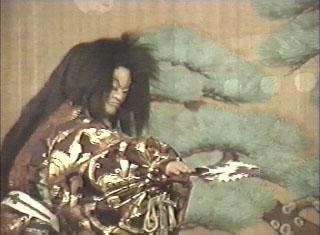
The great dragon arrived, saw the tempting bait laid out for him, and began to dip each of its heads into a corresponding vat.
Once it had drunk its fill of the liquor, it became deeply intoxicated. According to most versions of the story, the dragon fell into a deep sleep, whereupon Susano-O killed it.
Other versions, however, represent Susano-O and the drunken Orochi dragon as having engaged in a fierce hand-to-hand combat.
After the battle, Susano-O found a magnificent sword endowed with supernatural powers, Kusanagi-no-Tsurugi (“the Grasscutter”).
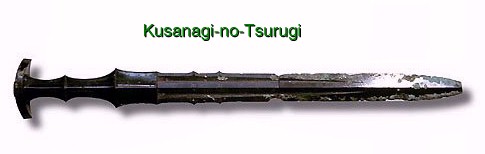
On obtaining this divine weapon, Susano-O presented it to his sister, Amaterasu, as a gesture of atonement and respect.
Another tale that shows his caring nature involves repaying kindness that he received from a very poor man. In return for his kindness, Susano-O told him how to prevent his home from ever being plundered by the Plague God.
The method was simple: The man was to hang a plaited straw rope across the entrance of his house. That is how the custom of preventing epidemics by hanging straw ropes (shimenawa) came to be tradition.
Further evidence illustrating Susano-O's good nature involves one of his sons, O-Kuni Nushi, and O-Kuni-Nushi's half-sister, Suseri-hime.
Final Reflection
It is important for Western readers not to misunderstand this Kami. I did not find anything in the stories I read concerning Susano-O that showed him to be essentially bad.
On the contrary, he is recognized as a courageous deity who helps in the struggle against evil and who graciously subordinates himself to the supreme Kami of heaven.
As far as I am concerned, Susano-O is one of the most personable and fascinating of the Shinto gods.
May the storm god always help you reap great rewards from your fields.
Sources
- Campbell, Joseph. The Masks of God: Oriental Mythology. Viking Penguin, 1962.
- Guirand, Felix, Ed. New Larousse Encyclopedia of Mythology. Prometheus Press, 1972.
- Nihongi (Chronicles of Japan from the Earliest Times to A.D. 697). Translated by W.G. Aston.
- Tsunoda, Ryusaku; de Bary, William Theodore; and Keene, Donald. Sources of Japanese Tradition.
Commentary
I believe that the preceding story shows that Susano-O could sometimes have a kind and loving personality. It also shows that he had the power of transforming.
Susano-O is multifaceted. That is probably why I find him to be such a fascinating character.
Many compare his descent to earth with that of the biblical devil, Satan, but I do not agree. I find that the stories that show his supposed “rough personality” really reveal him to have very human qualities.