Introduction: What is Zen?
"ZEN" means: Doing what you are doing as well as possible. Through training, this succeeds better and better.
Zen is not moralistic: you must decide for yourself what you do and do not do. "As well as possible" means: independent of outside pressure. It is a trick, a skill that can be learned, however: this is not easy!
- Meditation
- Concentration!!
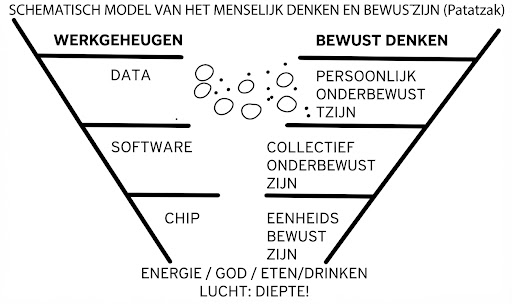
Thinking and the Human Model
Compare human thinking to the operation of a computer:
WORKING MEMORY
CONSCIOUS THINKING
DATA
PERSONAL SUBCONSCIOUSNESS
SOFTWARE
COLLECTIVE SUBCONSCIOUSNESS
CHIP
UNITY CONSCIOUSNESS
----------------------
---------------------------------
ENERGY / GOD
FOOD / DRINK / AIR: DEPTH!
Over time, human experience sinks down into deeper levels of abstraction in human thinking.
What hinders concentration during thinking/working/reading, etc.? 99% internal factors (bubbling up from within yourself), and 1% external factors.
Zen definition: Being able to think what you WANT to think (CONCENTRATION).
Points and Bumps
When you gain experiences, you store them in your body:
- Well-processed: Stored as efficient "points" that take up little space and of which you can store many.
- Not well-processed: Stored as points with an emotional charge around them: "bumps".
Bumps take up more space and continue to affect your feelings. At moments when it is inconvenient for you, they surface and unasked disturb your thinking (when you do want them to, they do not surface). They also disrupt the flow of energy to your conscious thinking and express themselves physically (insomnia, illness, tension) and through communication disorders.
The goal is to convert bumps into points through a healthy processing process.
Zazen: Meditation as a Solution
How do you process bumps and store new experiences as points?
Take time to process bumps (achieve relief) via the personal or collective subconsciousness. A proven method for this is ZAZEN (practicing seated Zen: sitting as still as possible in a specific posture and concentrating / meditating).
The trick: To let bumps surface, you should specifically *not* think about them; then they manifest themselves naturally!
The Meditation Posture & Instruction
- Sit on the edge of a cushion (approximately 15 to 20 cm high).
- Place the heel of your right foot against the cushion, and the heel of your left foot against the instep of the right foot.
- Tighten your back so it is hollow and sit upright; relax your shoulders.
- Bring your hands together at navel height: the hand you write with is on the bottom, the fingers of the other hand rest on top of the bottom hand.
- Bring your thumbs together and form an oval between the palms and thumbs.
- Keep your head straight, as if pulled upward by the crown of your head; focus your eyes on a spot about 1.5 meters ahead on the ground.
- Breathe in and out through your nose.
- Concentrate on counting every exhalation in silence, from 1 to 10, and then start over again.
If bumps (thoughts/emotions) come up: look at them, let them go, and start counting again (or continue counting if you still know the count). You have become AWARE of the bump. Respect the limit of the bump, do not act out the emotion at that moment, but continue counting. The images will be relativized and will return until they are stripped of their charge.
Practical Life Lessons and Concentration
- Living in the NOW: If you think "this is so nice, I wish this lasted longer," the pleasantness has already passed. Concentrate on the NOW to control the speed of time.
- Talents: Your talents (language, drawing, arithmetic) are hidden in the third layer of thinking (collective subconsciousness). We only use 10% of our talents? By acting more efficiently and with higher quality, you save time for other talents.
- Tackling Problems: Do not tackle a problem at the moment it occurs (such as traffic detours during an accident), but at a moment when it does not occur (e.g., in the morning before breakfast) via meditation.
- Responsibility: If you point an accusing finger at someone else, one points to God (fate) and three point to yourself. 20% is fate, 20% the other person, 60% is yourself.
Symbols and Archetypes
Our collective subconscious is stored in the form of symbols and archetypes (primal models, such as mother, thief, king, ring, light). The more consciously you deal with them, the more you can remain yourself. Choice of words and dreams indicate which symbols are important to someone.
Stress, Happiness, and Hormones
- Negative stress: Experienced during coercion, force majeure, illness, waiting, injustice. The hormone involved is adrenaline (blocks thinking, intended for fight/flight).
- Feeling of happiness: Experienced during success, music, children, love, appreciation, sex, sun, sports, relief, being healthy, dancing, a grip on life. The hormone involved is endorphin.
"We are like deep-sea fish: when the pressure drops, we explode with happiness."
To be happy, there must be balance. Happiness does not lie in environmental factors, but in the way you deal with them: your thinking!
Advice: Meditate for fifteen minutes twice a day (in the morning before breakfast and in the evening before sleep, at least an hour after eating).
Conditioning & Endorphin on Command
By meditating in an uncomfortable position and counting to 10, the body learns to produce endorphin. If you start counting your exhalations in a stressful situation, the body reacts immediately by producing endorphin, and you feel better. Stress no longer has a hold on you, and you prevent storing new bumps.
Koan
A KOAN is a game of 1700 questions formulated in the language of the subconscious (software). Answering them yields deep self-knowledge, teaches you your own thought patterns, and helps you break free from your conceptual frameworks. Counting from 1 to 10 ultimately yields the same result.
Self-Confidence & Planning
Formula for self-confidence: The percentage of successful plans.
- Make detailed plans and break large plans down into many small pieces (avoiding "all or nothing").
- Keep an action list in your agenda and check off what has been done.
- Combined with Zen meditation, this leads to a yield increase of 10% to 30% and rising self-confidence.
Evolution of the Brain
- Spinal cord: Unity consciousness, bodily functions (reptiles).
- Brainstem: Collective subconsciousness (higher animal species).
- Limbic system: Emotions (apes).
- Cerebral cortex: Rational functions, language, planning, thinking (humans).
Problems arise when the cortex becomes too dominant and the rest of the body pushes back. Zen restores the necessary synchronicity and integration between thinking and feeling, which creates new energy and peace.