Among the vast numbers of the Shinto Kami discussed in the Kojiki (Records of Ancient Matters, 712 CE), three of the most important are the foundational Kami of the "Plain of High Heaven."
The names of these creator gods are as follows:
- Ame no Minaka-Nushi no Mikoto (Heaven-of-August-Center-Master)
- Takami-Musubi no Mikoto (High-August-Growth)
- Kami-Musubi no Mikoto (Divine-August-Growth)
There are many different versions of the original creation story in the old Shinto texts, and as Aston notes there is little or no agreement about the specifics (Nihongi 3, note 5). Several traditions identify Ame no Minaka-Nushi as the first primordial being to come into being. Others, however, describe him as the second, third, or fourth Kami to take form, suggesting that there were other, still more primordial Spirits before him (ibid. 5, 7). Despite such differences concerning the particulars, however, a discernable pattern is clear throughout all the versions. There is general agreement that the Primordial Kami generated one another sequentially, and also that Ame no Minaka-Nushi preceded Takami-Musubi and Kami-Musubi. These heavenly Kami were at home within the indistinct and amorphous state of the Chaos. Therefore, the first several generations of Kami did not remain as definite presences, but successively entered, and then receded again, from the realm of differentiated being.
The Kojiki tells the creation story in simple and poetic terms:
Ame no Minaka-Nushi, in this version, was the first distinct being emerge from the mists of Original Chaos. This Kami did not deign to stay within the realm of form, however, but took shape only long enough to bring into being the next heavenly Kami, Takami-Musubi and Kami-Musubi. After that, Ame no Minaka-Nushi disappeared and is never mentioned again in either the Kojiki or the other collection of ancient documents, the Nihongi (Chronicles of Japan, 720 CE).Now when chaos had begun to condense, but force and form were not yet manifest and there was nothing named, nothing done: who could know its shape? Nevertheless Heaven and Earth parted, and Three Spirits began the work:
1. The Spirit Master of the August Center of Heaven,
2. The August, High, Wondrously Producing Spirit,
3. The Divine, Wondrously Producing Ancestor.
These appeared spontaneously and afterward disappeared. But the young earth, like floating oil, now was drifting . . . (Kojiki, quoted in Campbell 467)
This silence in the Shinto scriptures is remarkable, especially in light of the deity's clear priority in the order of creation. There are two possible explanations for this fact, both of which may contain some part of the truth: (1) Because of this Kami's extremely abstract nature, it has seemed too remote to be much relevance to mundane human affairs. Consequently, it may be that the worship of Ame no Minaka-nushi never took hold in the popular cult, so that this Spirit eventually became what Eliade has termed a deus otiosus, or "superfluous god" (Eliade 93-113). (2) Due to the deep mystery surrounding this High Kami, devotees appear to have deliberately concealed their most profound teachings and practices regarding it. As one eighteenth century Western observer reported, it was customary for the old Shinto masters to make every disciple swear an oath, "signed with his own hand and seal, not to profane such sacred and sublime mysteries by discovering them to the ignorant and incredulous." Even today, various esoteric Shinto cults exist which attach supreme importance to Ame no Minaka-Nushi, but refuse to discuss their ideas or experiences with outsiders (Herbert 240).
Despite the lack of scriptural references, there has been no shortage of speculative philosophizing about this Kami on the part of Shinto theologians. One, for example, proposes that it is "the center of all Kami, more universal and more eternal than all Kami"; while another thinker suggests that it is actually not a Kami as such, but rather is beyond all Kami, "the central pillar of the world, who appeared in the chaos, nobody knows wherefrom" (cited in Herbert 238). G. Kato maintains that the cult of this supreme Spirit represents a form of primitive monotheism, which was supplemented but never replaced by the worship of the subordinate Kami who arose thereafter (ibid.). A British student of Shinto characterizes Ame no Minaka-Nushi as "the creative impetus, initiating itself and thereafter self-developing." The same scholar emphasizes the difference between this fluid conception and the Western doctrine of an omnipotent agency that controls events deterministically (Mason 51). Still other investigators stress the intermingling of immanent and transcendent aspects that they find in this deity. The following quotation comes from Katsuhiko Kakehi:
Although usually represented as male, Ame no Minaka-Nushi has sometimes been associated with Toyo-Uke-Bime no Kami, the Food Goddess. Toyo-Uke-Bime enjoys tremendous prestige in Shinto, being regarded as the sustainer of all life. It is noteworthy that some Shintoists regard her as the personified aspect Ame no Minaka-Nushi, others as the encompassing totality of that deity. To be sure, there are also those who indignantly reject these characterizations. In any case, the close identification of Toyo-Uke-Bime with Ame no Minaka-Nushi may point back to a time in early Shinto history when the Ultimate Divinity was regarded as neuter, or as androgynous.Ame no Minaka-Nushi exists both in and above the empirical universe. He is both immanent and transcendent. He surrounds the visible world and partakes of its nature just as an outer enveloping circle or sphere includes but transcends a smaller concentric one. Thus dwelling above the phenomenal universe of human experience, he is yet a most intimate and inseparable part thereof. . . . The designation naka (center, or middle) in the name of this Kami is not to be taken as indicating localization in a central place in heaven (ama), considered as part of the existing universe. Centrality is referable to him not in a physical spatial sense, but in the sense that all depends on him. . . . He is without beginning, end, increase or decrease. He is the unaltering basis and background of flux in the phenomenal world, transcending all change. (cited in Herbert 238)
The next two Kami are both qualified by the by the epithet musubi, meaning "growth" or "production." They represent a further development of the first creative impulse by channeling it in different, though related directions. Because of this unitary meaning that pervades their respective functions, some Shintoists interpret them as constituting an interdependent dyad, perhaps even a single divine principle. One of the enduring puzzles concerning them is their respective genders. There is an ancient text, entitled the "Congratulatory Address of the Chieftains of Izumo," which refers to the Musubi pair as the "Divine Dear Male" and the "Divine Dear Female" (Herbert 241). In other old texts, Takami-Musubi and Kami-Musubi are both treated as males (e.g. Kitabateke 69). Modern scholarship seems to be about evenly divided between this view (e.g. Mason 52), or the view that Takami-Musubi is male and Kami-Musubi female (e.g. Herbert 241; Larousse 412-13). An interesting exception is Aston, who leaves Kami-Musubi's gender indistinct, while interpreting Takami-Musubi as female (Nihongi 81-82). Indeed, Aston tends toward the view that a single Spirit, "Musubi," would sometimes appear as one Kami, sometimes two, or sometimes as many as five, depending on the context. In any case, out of this confusion of numbers and genders, which may be intentional, the one clear motif to emerge is that these deities of growth are essentially complementary and interdependent.
Kami-Musubi no Mikoto symbolizes the principle of life, the nutritive potency sustaining both the vegetable and animal kingdoms. She (or he) is, so to speak, the ruling spirit of the biosphere, and as such is an essential component in all beings. It is the power of Kami-Musubi that provides the integrative function in things, weaving together the fabric of existence into a dynamic whole. This deity is also the harmonizing principle, gentle and peace loving, who issues forth the elemental love that combines and blends. Many of these same qualities would later find expression in her son, Sukona-Bikona no Kami, the elfin spirit of agriculture who assisted O-Kuni-Nushi in taming the islands of Japan.
Takami-Musubi no Mikoto, on the other hand, represents the principle of mind. He (or she) is the ruling spirit of the entire realm of thought, and as such is the agency that endows sentient beings with self-consciousness. It is Takami-Musubi that enables individuals to distinguish forms, recognize patterns, and impose the structures of rationality on the order of the universe. This is the deity whose resourcefulness and leadership skills would guide the other Kami in times of hardship, finding explanations for things, formulating clever strategies and plans. These same virtues would also be preeminent in his (or her) son, Omoi-Kane no Kami, the "Thought-Combiner Kami," who devised the brilliant stratagem to reclaim Amaterasu from her self-imposed exile in the Rock-Cave of Heaven.
Unlike the other two Primordial Kami, Takami-Musubi continued to play a prominent and visible role in the early events of Japanese mythology, after successive generations creation had populated the universe with millions of lesser Kami. Book II of the Nihongi details his efforts to establish divine rule on earth, especially in the "Central Land of Reed Plains," i.e. Japan. The first paragraph of this section records how distressed the Kami of heaven were to observe far below them "numerous Deities which shone with a lustre like that of fireflies, and evil Deities which buzzed like flies" (64). At that time, O-Kuni-Nushi no Kami and his cohorts were struggling to establish hegemony in Japan, but they were experiencing great difficulty in the face of rebellious rival factions. Takami-Musubi, therefore, looking down from above, determined that this situation was intolerable and must not continue. So he called a high council of the heavenly Kami and posed the critical question: whom should they send down to subdue the Central Land of Reed Plains? The Kami deliberated, and finally decided on Ama-no-Hohi no Mikoto as being the worthiest and most heroic among them. Therefore Takami-Musubi sent down Ama-no-Hohi, but the latter soon forsook his mandate and allied himself with O-Kuni-Nushi. Then another hero was sent down, and he too quickly went over to the other side, never sending any word back to the heavenly Kami.
The third Kami to be chosen was Ame-Wakahiko, a very resourceful and ambitious leader. Takami-Musubi, giving him a divine hunting bow and heavenly arrows to assist him, sent him down to the Central Land of Reed Plains. No sooner had Ame-Wakahiko arrived, however, than he set about claiming hegemony on earth for himself. He married the daughter of an earthly Kami, built a powerful fortress, and established his own court. The Kami in heaven waited in vain for word from him. At length, Takami-Musubi sent down a messenger bird, the divine pheasant Nanaki, to report on what was happening below. When Ame-Wakahiko became apprised of the bird's presence, he immediately shot it with the divine bow and arrow. Magically, the bloodstained shaft returned to Takami-Musubi, who, seeing the evidence of Ame-Wakahiko's treachery, threw the arrow back down to earth, piercing the Kami's heart and killing him.
A fourth time, therefore, Takami-Musubi assembled the Kami of heaven. This time, he prevailed on them to send down the August Son of Amaterasu herself, Masa-ya-a-katsu-katsu-haya-hi no Oshi-ho-mimi no Mikoto ("Truly-I-Conquer-Conquer-Swiftness-Heaven of Great-August-Person"). This latter deity, however, did not live up to his name as a great conqueror; for as soon as he descended as far as the Floating Bridge of Heaven and surveyed the tumultuous territories down below, he immediately gave up the undertaking as being too onerous for too little gain. Ame no Oshi-ho-mimi (to use the appropriately shorter version of his name) turned back to heaven and yielded up the divine mandate he had received from Takami-Musubi and Amaterasu.
One important contribution that Ame no Oshi-ho-mimi did make, however, was to ally himself in marriage to Takami-Musubi 's daughter, Taku-Hata-Chichi-Hime ("Princess Myriad-Mulberry-Looms"). In this way, the two most powerful families among the heavenly Kami became united.
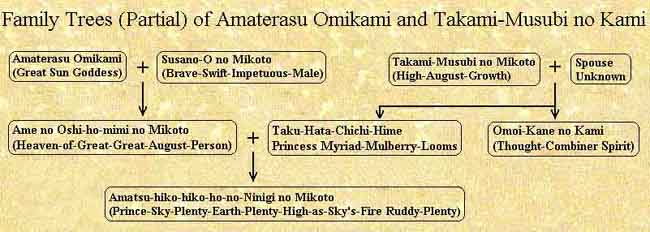
Subsequently, seeing that their previous plans to colonize the Central Land of Reed Plains had so far been unsuccessful, Amaterasu and Takami-Musubi decided to send down their mutual grandson, Amatsu-hiko-hiko-ho-no-Ninigi no Mikoto. The August Grandchild, endowed with the combined strength of his maternal and paternal ancestors, and supported by a myriad of accompanying heavenly Kami, was finally able to descend and complete the long-awaited task. He won the allegiance of O-Kuni-Nushi, subdued the rebellious spirits of the earth, and established the imperial line that was to rule for millennia in Japan.
Takami-Musubi, having thus completed his divine mission regarding the earth, retired into obscurity and did not again play an active role in earthly or celestial affairs.
There is disagreement among scholars about the extent to which the Three Primordial Kami of Shinto were truly objects of devotion in the past. According to some sources, they never had a significant place in the popular religion until modern times. This judgment is based on the paucity of long-established shrines consecrated to these deities and the lack of special religious holidays dedicated to them. Other scholars counter, however, that the explanation for this apparent lack of interest within the populace may be that the primary devotees of the cult have been esoteric Shintoists — those who practice secret rites for the cultivation of occult powers and ecstatic states of consciousness. These groups have traditionally been small and ascetic, with shrines situated by preference on remote mountaintops: hence, their forms of worship have received scant attention. Nevertheless, there are numerous side altars in shrines throughout Japan that are devoted to one or another of the Primordial Three, and even a small number of ancient shrines dedicated exclusively to them (Herbert 242-43).
The worship of these Kami experienced a rapid renaissance due to political developments at the end of the nineteenth century, when the Meiji regime came to power. The new government instituted the practice of State Shinto, as opposed to Sect Shinto. The purpose of this distinction was twofold: on the one hand, it was a response to pressures from the Western powers, who were then clamoring for more religious freedom in Japan (and for greater access for their Christian missionaries). To answer these demands, Sect Shinto (the many and various forms of the popular religion) was put on a level with all other competing religions, and the Japanese government was able to declare, in 1889, that "Japanese subjects shall, within limits not prejudicial to peace and order and not antagonistic to their duties as subjects, enjoy freedom of religious belief" (Kitagawa 212). On the other hand, however, State Shinto (the veneration of the Emperor and his divine ancestors) received official sanction as the patriotic duty of all Japanese citizens. The justification for this was that it would instill sound moral values of loyalty, conscientiousness, and obedience to authority. Since the imperial line of descent traced through Ninigi all the way back to Amaterasu, as well as Takami-Musubi, Kami-Musubi, and Ame no Minaka-Nushi, those four Kami were designated as the Supreme Kami of State Shinto (216). Spurred on by this ideological imperative, State Shinto thrived outwardly; yet inwardly the emperor cult suffered from corruption under the influence of governmental manipulation. Not until the end of the Second World War did this unfortunate abuse of religion come to a well deserved end.
It remains at this point a still undecided question whether the Japanese people will as a whole turn away from worshipping the Three Primordial Kami, feeling that their cult is tainted by discredited government policies of the past, or whether they will seek to reclaim and creatively transform this ancient religious heritage. In the latter case, it is possible that Ame no Minaka-Nushi, Takami-Musubi, and Kami-Musubi will once again assume positions of prominence, inspiring future generations of Shintoists with their rich potential for theological speculation and symbolic insights.
Campbell, Joseph. The Masks of God: Oriental Mythology. New York: Viking Penguin, 1962. Campbell's passage from the Kojiki is a slightly amended version of the translation by Basil Hall Chamberlain, trans. 2d ed., with annotations by W. G. Aston. Tokyo: J. L. Thompson & Co., 1932.
Eliade, Mircea. Myth and Reality. Translated by Willard R. Trask. New York: Harper & Row, 1963.
Guirand, Felix. New Larousse Encyclopedia of Mythology. New York: Paul Hamlyn, 1959.
Herbert, Jean. Shinto: At the Fountain-Head of Japan. London: George Allen & Unwin, 1967.
Kitabatake Chikafusa. Jinno Shotoki: A Chronicle of Gods and Sovereigns. Translated by H. Paul Varley. New York: Columbia University Press, 1980.
Kitagawa, Joseph M. Religion in Japanese History. New York: Columbia University Press, 1966).
Mason, J.W.T. The Meaning of Shinto: The Primeval Foundation of Creative Spirit in Modern Japan. New York" E.P. Dutton, 1935.
Nihongi: Chronicles of Japan from the Earliest Times to A.D. 697. Translated by W.G. Aston. London: George Allen & Unwin, 1956.
↑