The Buddha made rules in the interest of the monks and nuns to to pursue a fair policy. Thus it became the community made easier in judging moral issues exposed came when such a situation arose. The Buddha thus stated certainly the spirit of moral justice by which we become able made to interpret the law correctly, in contrast to the wording of some aspects of our current legal policies today. At the time of the Buddha, and even later, there were kings who lived there took advantage of and used those rules to supplement their own law.
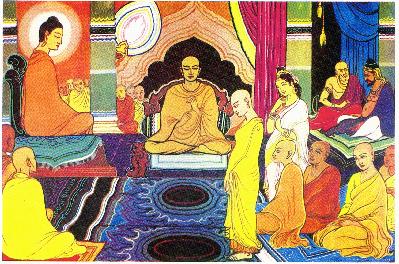
The judicial procedure adopted by the Buddha becomes clear illustrated in the case of the Arahat Theri Kumara, the mother of Maha Kassapa. She was unaware of her pregnancy at the time her husband gave her permission to leave the family and enter the Community of Nuns (Bhikkhuni Sasana). Later, when she was found in an advanced stage of pregnancy, the nun was charged with a serious but unjustified charge of sexual misconduct. And so she was asked to appear before a religious court to appear. The Buddha gave Venerable Upali, one of his foremost arahat disciples about the knowledge of the Basket of Rules Vinaya Pitaka, the command to act as leader and to enforce the justice of the innocent victim. The audience consisted of monks, nuns and lay people, including the lay woman Visakha. Visakha screened the victim outside the Buddha's presence and the rest, and after careful investigation and confidential interrogation declared she that the nun was completely innocent. When the arahat Upali heard the evidence, he acquitted the nun of any offense.
| Auteur: Peter van Loosbroek -- Ananda Copyright: www.sleuteltotinzicht.nl/glb_copyright.htm |