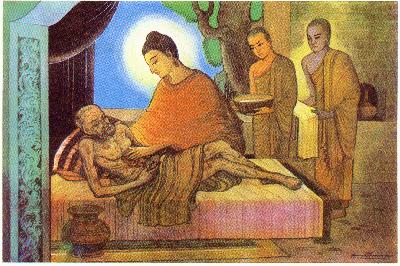
Despite the fact that at the time of the Buddha the study and practice in medicinal and surgical science had been developed to a great extent, little attention was paid to nursing and caring for to the sick. Putigatta Thera Tissa was a monk who was afflicted with a skin disease that affected his entire body. covered with sores. When his fellow monks ignored him, his condition. The Buddha went to the sick monk who is now dying near, bathed him with the help of Ananda Thera and changed his robes and robes. After the Buddha made him a little more agreeable, he preached his Teachings to him through him explain the true nature of the human body. Illuminated by the speech, the elder (Thera) became an arahat. Then the Buddha addressed the other monks about the noble task to take care of the sick. Because of the Master's compassionate admonition and following his noble example, lay followers started infirmaries to be built in all the great monasteries. Later, King Dhammasoka not only built hospitals for people, but also for animals. And so is the first establishment of hospitals (at least for animals) attributed to Buddhists. A Buddhist considers every sentient being as a being who has the right to good care and happiness.
The event about Putigatta Thera Tissa can be read in Dhp041.
| Auteur: Peter van Loosbroek -- Ananda Copyright: www.sleuteltotinzicht.nl/glb_copyright.htm |