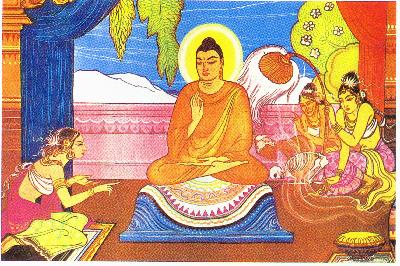
The Buddha teaches that all things are in a state of flux or change to be around; therefore all things are ephemeral. The ever-changing nature of both mind and body proves the inauthenticity or imperfection of life and the instability of existence.
Because Khema, the other half of king Bimbisara, knew that the Buddha taught this , she tried every time she got the visited the temple, to avoid a meeting with the Buddha. Because they are extraordinary beautiful, she was afraid that the Buddha would disdain her self-consciousness about her self-righteousness. He might talk about the to speak of the transitory nature of things. But one day, the king will bring her to the Buddha anyway. The Buddha created with his superworldly gift just before Khema a mirage of a beautiful woman. He let the figure age steadily. Whenever Khema with her eyelids blinked, the woman grew ten years older: first she was middle-aged, then of old age and then someone of very old age that could no longer be of any use.
Through this image Khema understood what was also true for her, namely anicca, dukkha and anatta; i.e. impermanence, suffering, and that all things without a permanent be self or soul. Understanding these three qualities ti lakkhana that are hidden in all things is most important to enlightenment. reach. And Khema understood this. She fell to her knees before the Master and showed her gratitude for this change in her understanding which radically changed her life.