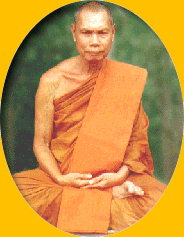

When we sit in meditation, we should always be careful not to touch the person next to us,
because this prevents the mind from concentrating. If concentration arises, it will be lost again
through such contact.
We remember that the Buddha is in our heart, the Dhamma is in our heart,
and the Sangha is in our heart. The Three Jewels are truly within our heart,
and we need think of nothing else. When we think only of the Three Jewels,
the mind quickly gains concentration. We honor the Buddha through our meditation.
This is what the Buddha taught us.
First, we try to bring the mind into a calm and relaxed state.
The right leg is crossed over the left, the right hand rests in the left,
and the back is kept upright. This is the correct posture for meditation.
Close the eyes and try to see yourself sitting in this posture.
When we breathe in, we note BUD-; when we breathe out, -DHO.
This is the Buddha. The Buddha himself attained enlightenment through mindfulness of breathing
(Anapanasati). We know when we breathe in and we know when we breathe out.
This strengthens mindfulness and clear comprehension in the mind,
allowing concentration to develop quickly.
Keep the mind relaxed and natural. When we feel the body becoming light
and the mind becoming light, we know that concentration has arisen.
We do not try to force this state. If light appears, we know it;
if no light appears, we also know it and remain undisturbed.
We stay relaxed, knowing and letting go.
Joy arises with the in-breath and joy arises with the out-breath.
When we feel this joy and the lightness of body and mind,
we know that concentration is present.
We can now focus on the point between the eyebrows.
Here knowing and seeing arise.
We do not look outward, but see ourselves.
We meditate to follow the example of the Buddha,
to understand as he did and to attain enlightenment.
Now we direct attention to the hair on the head.
We know the hair and try to see it.
If we cannot yet see it, we simply note: hair, hair.
We practice in order to understand birth, aging and death,
and the Dhamma that is free from birth and death.
The four foundations of mindfulness are practiced in all postures:
sitting, walking, standing and lying down.
If drowsiness arises, it is a sign that we have forgotten to note.
Breathe in more deeply than usual with BUD-,
and breathe out more strongly with -DHO.
Mindfulness increases, rapture arises, and drowsiness disappears.
If drowsiness persists, stand up and continue with walking meditation.
Right foot forward: BUD-, left foot forward: -DHO.
Drowsiness and reluctance to practice are among the five mental hindrances
and can be overcome in this way.
When concentration arises, confidence in the Buddha and his teaching arises.
The hindrances fade away, restlessness subsides,
the body becomes light, the mind becomes light,
seeing and knowing arise.
Following the Noble Eightfold Path leads to special abilities
and to the ending of all suffering - to Nibbana.
The Buddha taught the path; now it is up to us to practice it.
Our body consists of the four elements and energy.
When concentration deepens, some experience lightness of body and mind,
others experience light.
At this stage many experiences arise.
We must overcome the hindrances to proceed.
Pain may arise; we know it.
If it becomes strong, we change posture and know this.
When pain ceases, joy arises.
We meditate to bring suffering to an end.
Loud sounds can disturb concentration.
We must develop equanimity.
When sounds no longer disturb us, true calm has been developed.
This wisdom is applied to all sense contacts:
eye and form, ear and sound, nose and smell,
tongue and taste, body and touch, mind and thought.
We know contact occurs and remain in equanimity.
Through letting go, emptiness (Sunyata) becomes clear.
This is not self, does not belong to us, is not under our control.
This Dhamma leads to liberation.
When we can meet all experiences without losing balance,
equanimity and one-pointedness arise.
This must be trained.
Nibbana is not far away.
It is here, in our heart.
When the mind is calm and present,
there is no anger and no greed.
May all beings put an end to suffering.