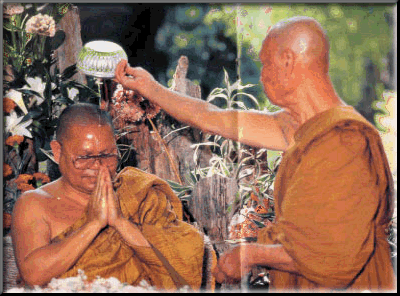

Students of the Dharma, we have undertaken the precepts and thus established the foundation. We take refuge in the Buddha, the Dharma, and the Sangha. We try to know the mind. For this, we do not need to leave our body. We simply imagine that the Buddha is in our heart. We imagine that we are living in the time of the Buddha and that he is teaching us the Dharma. We remain within our mind and do not go outside. Think the word BUD- as the air flows into your nose — think the word -DHO as it flows out again. Imagine your body as if it were a Buddha image. You are a Buddha image sitting in meditation. Close your eyes and see this image. You do not need to look at anything else; you see only your body sitting in meditation. Look at the parts of the body and know what you see; remain with the body.
As meditators we remain inside; we do not go outward to the sense doors. We stay with the body and the mind. Now we are only mind. If you were to open your eyes now, you would see only things outside yourself. We do not do that; we remain only within our own body and mind. Know that you are sitting in meditation. Be clearly aware of your sitting posture. The right hand rests in the left, the right leg over the left. You sit in the same position as a Buddha image. The mind remains calm and you see the true nature of body and mind.
Direct your attention now only to the breath. Inhale BUD-, exhale -DHO. That is all that is present — nothing else. Only the breathing, no feelings, no judgments, no emotions. You are calm and peaceful. Fix your attention now on the third eye between the eyebrows. When you fix it — think “seeing.” If you see nothing, think “knowing.”
There is no more wholesome activity than meditation. No matter how much good you may do, nothing is more wholesome than meditation itself. Students of the Dharma, you yourselves will know what is real — the true nature of things. When you develop concentration, when you meditate, you follow the path of the Buddha. Following the precepts creates good karma, but this karma is not comparable to the good karma that arises when you meditate. There is no other way to reach Nibbana. Any worldly activity — however wholesome — cannot be compared with meditation. Only through meditation can you experience that the teaching of the Buddha is absolutely correct and verifiable. There is no other means to verify this. You must experience it yourselves. This happens through wisdom, which in turn arises through meditation.
Progress shows itself when you notice that you are becoming calmer and more peaceful. The body becomes light, the mind relaxed and clear. It is unnecessary to go outside. Remain in your body and mind and know. Maintain the vision of your body as a Buddha image. Know that the mind has now reached concentration. Wisdom shows you the true nature of things: they arise, grow old, and pass away. Know your body and know your mind. Know that in this way you follow the teaching of the Buddha; you are on the path. Note during inhalation BUD- and during exhalation -DHO. It is a very calm feeling; you do not become involved in anything. There are no feelings, no emotions; you just sit there — as the Buddha sat. Air flows in BUD-, air flows out -DHO. There is nothing else, absolutely nothing. Mindfully follow the stream of air as it enters and follow it as it leaves. In this way your attention will rise to the body.
When you sit, you are not sleepy; the mind is fresh and aware. You have full awareness of the body. Make sure that the head does not fall forward, otherwise you will feel pain when you leave meditation. Sit upright. Without mindfulness it is possible that you fall asleep. Stay with BUDDHO during inhalation and exhalation so that you remain awake.
When you observe the in-breath and out-breath, joy and calm arise — know this. This state of happiness, this tranquility of mind, will give you confidence. It prevents dissatisfaction from entering your mind. It prevents anger, tiredness, or other unwanted mental states from arising. Thus you prepare the mind to see the true nature of things. When you truly see, do not judge what appears. Do not try to compare it with things you already know. Simply allow the mind to observe what arises. Do not become involved. Whatever you see, whatever you know — just note “knowing.” Know that you are meditating; know when the mind is calm and know when it is not calm. In this way you can see the truth. In this way you follow the Buddha. What he realized so long ago — you can realize now.
If the mind is restless and confidence does not arise, think often of the Buddha and confidence will naturally appear. Joy, rapture, and interest in practice will arise — if you only think of the Buddha — they will arise when you meditate. Thus the five jhana factors arise: Vitakka, Vicara, Piti, Sukha, and Ekaggata. Vitakka directs the mind to the object, Vicara reflects upon it, Piti is rapture, Sukha is supreme happiness, Ekaggata is one-pointedness.
You need a reference point — in meditation the body should be your reference point. Stay with the body. Observe it carefully and divide it into its individual parts. Look at it in every possible aspect. When concentration first arises, great joy will arise. Thus you are on the path of the Buddha. Extreme joy while inhaling BUD-, extreme joy while exhaling -DHO. Total mindfulness during inhalation and total mindfulness during exhalation. The Buddha was enlightened through contemplation of the breath.
As meditators you should always make sure that you sit upright. Do not allow the body to collapse; remain in this sitting posture — the same in which the Buddha is usually depicted. Thus joy will arise. Concentrate on the point between your eyebrows. In this way you will see the absolute truth. Concentrate on the hair on your head. See how it grows from the scalp, see its color. Look at the body hair, see how it grows all over the body. Look at your fingernails, see how they are attached to the fingers. See their roots, see how they have grown and how they look at their ends. It is not necessary to go outside; see only the body and the mind, as the Buddha taught.
There is no better way to pay respect to the Buddha than to follow his path, to do what he did. It is necessary that we recognize the true nature of things. It is necessary to see birth, aging, and death. Of course, it is easy for each of us to see aging and death — but do we truly understand them? They are only words for us — growing old — but we should truly understand what it means to grow old. Suffering is only a word, but we do not truly understand it. We are too deluded to really understand. We live in our world of delusion. The only way out is the path that the Buddha — out of great compassion for all beings — taught. The only way to understand everything is meditation. Only in this way can you experience the absolute truth.
Everything in this world is a delusion. We give things names and these names cling. Suffering is a word and dying is a word, but these names are not reality. This is what we should realize — reality.
We have come together here to meditate. Let go of thinking now. Try to calm the mind, make it peaceful, so that you can see the true nature of things — thus we become students of the Dharma.
The important things are very close to us — it is our body and our mind. Yet we always look outward. We meditate and want to see angels or spirits. This is completely unnecessary. Once we understand the true nature of things, such phenomena arise by themselves. Therefore, concentrate on what is essential. The Buddha taught to go inward. With closed eyes you will see just as with open eyes. You see your body and your mind. That is what the Buddha teaches.
Whether you are awake or asleep, always think of the Buddha. Think of the Buddha when you sit, stand, or walk. Think of him as often as possible. In whatever you do, try to be as mindful as possible. Thus knowledge will arise within you. Thus you will realize the teaching of the Buddha. You will recognize the true nature of everything. You will see that everything consists of the four elements: fire, water, earth, and wind. While eating you will see it. Clarity will arise and you will improve. Pay very close attention to this; it is an important part of the teaching.
Students of the Dharma, you will know the true nature of things — truly know. Then you will need no one to explain it to you — you will understand for yourselves. Examine your body; go through it completely. See the hair of the head, the hair of the body, see the nails, the teeth, and the skin. The teeth are part of your body; the skin envelops it; the bones are inside the skin. All the large and small organs are in your body. Enter your body and see. Examine the body carefully. Since you were born, you have never really looked at it. Now look at it closely to see its true nature. When you investigate in this way, wisdom will arise. It is not necessary to go outside; it is not necessary to look into the distance.
There are different kinds of “wanting.” Most lead to suffering. The wish to reach the end of suffering, the wish to become enlightened, is a wholesome desire. You should have this wish often. This is called “wholesome desire.”
If tiredness, pain, or discomfort arise, change your posture and the pain will disappear. You should not let your mind suffer as well. If there is suffering in the mind, it is difficult to achieve a calm and peaceful state of mind. The body suffers and the mind suffers. If you change position, body and mind will feel at ease and you can continue your practice. The body is like a small child: when it comes into contact with suffering, it cries; when it comes into contact with something pleasant, it smiles.
Dharma is in your mind and body. It is like electrical energy. This energy can awaken radiant light within you. When we experience this, we feel incredibly happy. When this light of Dharma arises, it means that we now have concentration. With this concentration wisdom arises and through it we become capable of entering deep absorption. Whoever is capable of entering absorption develops special knowledge. What you have never known, you will know; what you have never seen, you will see; and what you have never heard, you will hear. Let this motivate you in your practice.
Meditation is like a life insurance policy. It secures you for life. Morality is the foundation, concentration is the fertilizer, and wisdom is the insecticide that protects the young plant until the fruits are ripe. Wisdom helps cut off mental defilements.
As meditators you should know when suffering arises and how it ceases. When you sit and pain arises, change posture and know that the suffering has ceased and joy has arisen. You must develop the three factors — morality, concentration, and wisdom — evenly. You should see them as equal in value. If you regard one of them as inferior, you cannot make progress. All these factors together can lead you to the stage of a Noble One.
You should see the body as it really is. When we see a beautiful woman or a handsome man, wisdom will tell us that it is not truly so. The body is a skin-bag with many holes. Everything inside this bag is not truly attractive. Everything that comes out of the holes is unpleasant and decaying. You see this; you see the reality of this body. Your eyes are no longer blinded by delusion. When you see reality in this way, the mind no longer tends to crave this body.
Food — we see food beautifully arranged on a fine plate; it looks delicious and expensive. With these thoughts we see food. In reality, the body needs nourishment in order to function. Whether the food is cheap or expensive, we consume it so that the body can work. It is medicine to overcome the suffering of hunger. That is all — nothing more.
You have ears to hear — with them you can hear the Dharma of the Buddha. You have eyes to see — now you can see the true nature of things with them. But without the Dharma you cannot see and you cannot know. You can only be a young man or a young woman for a short time. The people you love are attractive only for a short time. This desire will dissolve again. We do not want to know and not want to see this. But we must grow old and we must die. Just look at this. Look at the sick, look at the old, and look at the dead. The Buddha and his teaching invite you to see — to see and to know for yourselves — and you will be happy and content when you know and see for yourselves.
If your wisdom is not yet very developed, you should work on it. That is why you are here — you should practice and experience for yourselves. Thus the teaching becomes your Dharma. You will then no longer have to believe something just because someone says it. You will know for yourselves. You have attained mastery when you have reached stream-entry.