TEACHINGS OF LUANGPHOR PUTT
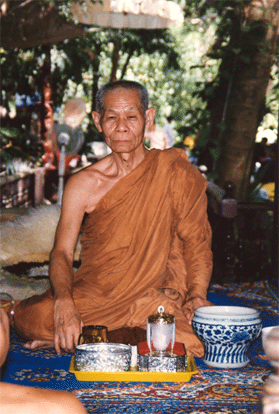
EMOTIONS
EMOTIONS
In the beginning one notes BUDDHO, BUDDHO – thoughts appear, one thinks. When one becomes aware of thinking, one brings the mind back to BUDDHO. Sometimes one sees the thoughts and knows: there is thinking. One may think calmly, but one must always retain the knowing of it. If one does not wish to use a mantra such as BUDDHO, then one simply knows.
It is completely normal for thoughts to arise during meditation. One lets them go again and remains with the empty mind. This repeats itself over and over. One knows that there is thinking and one knows when there is no thinking.
The word BUDDHO is also thinking; when we note the rising and falling of the abdominal wall, that too is thinking – it is thinking that we want. Naturally, in the beginning the thinking we do not want appears much more frequently. We only need to use our attention and know that there is thinking – the value is the same. Someone with little meditation experience may in this case become too strongly attached to the technique.
Sometimes the mind becomes very calm and one thinks that such deep calm should not develop. Yet the mind is, as it were, drawn into this state of calm. On the other hand, it can happen that one does not want to think, but the mind keeps thinking incessantly, perhaps the entire night. What we must do is train and strengthen our attention. We know that there are thoughts and do not try to direct them in a particular way. We know them and let them be – that is the correct way of dealing with thoughts.
We know and know, and when attention and insight become stronger, we can see the mind in its three functions: first – it thinks continuously; second – it knows and sees the thoughts; third – it returns to the calm, thought-free state. It returns to the body.
One observes the body and one observes thoughts. Knowing comes and goes, calm comes and goes, attention knows. Thinking we call Vitakko, attention Vijanam. When Vitakko and Vijanam are present in the mind, insight into the Dhamma arises. The arising and passing away of what takes place in the mind is Dhamma.
The mind knows, attention observes, and gradually Samadhi (concentration) becomes stronger. Rapture (Piti) arises. When Piti is present in the mind, it is followed by a feeling of happiness (Sukkha). One knows that there is thinking and one knows that there are Piti and Sukkha, and lets the mind continue in this way.
Then it may happen that thinking suddenly stops. The mind becomes radiant and full of light. Rapture and happiness are present. The mind refines itself further and rapture and happiness fade away – what remains is one-pointedness of mind and equanimity. The perception of the body dissolves; Piti and Sukkha have disappeared.
As we sit here, we know that pleasant and unpleasant feelings arise. We experience pain and heaviness, calm and restlessness – all this we must experience because we have this body and this perception. When the mind enters deep absorption, the perception of the body disappears completely. When there is no perception of the body, feelings and emotions no longer have a basis to arise.
If perception is still present, then in meditation we experience Piti, Sukkha and thinking – what we call Vitakko and Vijanam. When the mind enters absorption and refines itself further and further, Piti and Sukkha gradually disappear and only the radiant, light-filled mind remains – the mind is on the path of Samatha.
The mind is detached and radiant – it seems as if it floats, filled with light, in space. I call this: the mind has space as its object. When this happens, the following characteristics are present – calm, light and complete freedom from thoughts; it seems as if there is nothing.
Some meditators believe that the mind on the Samatha path knows nothing. But the mind has gone through much. Understanding and insight into the Dhamma have arisen. Seeing and deeper understanding of the body, insight into impermanence, suffering and uncontrollability of things, and many other deep insights into the Dhamma have arisen.
At this point the mind enters Jhana – the state of calm of Samatha. Body and self have disappeared; only the luminous, floating mind remains. Sometimes the mind sends rays of light into the world and sees people, spirits, landscapes and the like. The mind, however, is not a self; it simply floats in space like the sun. Only occasionally does it send out its rays and see things.
One should not claim that the mind no longer knows anything. The knowing present in this state is completely free of judgments (Samutpanna). It sees the world and does not name it; it sees living beings and does not label them. When the Buddha reached this point of enlightenment, the knowledge of all his former lives and those of all beings arose in him (Popenivanusatinana).
Therefore no one should say that the mind on the Samatha path has no knowledge. There is thus no reason to fear that the mind will enter this path. When the mind is one, the meditator must only be careful not to become attached to it. One must make a strong determination to let go of things. Without this determination one will not truly be able to do so. The mind must be trained to let go automatically. If this determination is lacking, the mind is not yet on the right path.
Morality has its task, the mind has its task, and wisdom has its task. When morality, mind and wisdom fulfill their tasks, together they form a force called Sativinnayo. Sativinnayo is the guiding force.
The Buddha taught: heedlessness leads to the accumulation of unwholesome karma (Akusala). Mindfulness leads to the accumulation of wholesome karma (Kusala). This means that we develop Samadhi, reach Jhana and Nana, obtain insight and higher knowledge, see and understand the mind and many other things through mindfulness (Sati). This means that the most important point in our practice is the development of mindfulness. If we do that, no problems arise.
What then is wrong view (Micchaditthi) and what is right view (Sammadhitthi)? We should not worry about this too much. A simple rule makes it easier: everything that we know and let go of, which does not lead to problems or conflicts, is right view. Everything that leads to attachment and problems – attachment to a self, using knowledge to look into the minds of others, trying to solve their problems and correct them – that is wrong view.
So: we know and let go – that is right view. When we know and become attached: what is that? Why is it like that? – this leads to attachment and problems; that is wrong view. When knowing arises and is followed by the question: why is it like that? – then we must know: these are mental defilements (Kilesa). When these questions arise, we simply let them go.
This “wanting to know” is a habit we have built up in our mind over a long time. If we truly want to know, then we must simply sit still and be mindful. Not think ourselves. What arises – we know it; what passes away – we know it; simply knowing alone. The “wanting to know” and “wanting to see” must be let go of.
Things arise and pass away in the mind – we do not need to name them. When mindfulness is strong, it has the ability to identify things by itself and know what is what.
It may also happen that we sit down to practice and think: this shows impermanence, this shows suffering, there is no self – because we want to develop wisdom. But the mind becomes very calm and suddenly only mental calm remains. Whether insight, knowledge, seeing, calm or mindfulness is present – all of this is a result of practice; we cannot influence it.
All we can do is create the right cause. The right cause for the arising of wisdom is threefold: first – the determination to be mindful; second – the determination to contemplate, as a doctor applies his learned knowledge to examine his object (Vijanam); third – when thinking arises, one allows it and only applies mindfulness to it: one knows and does not get involved.
