Yakushi Nyorai
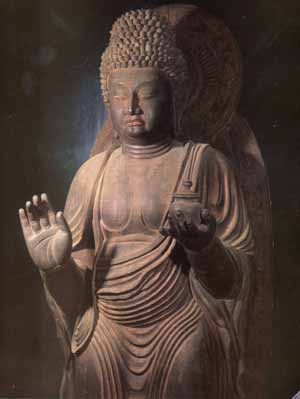
Yakushi Nyorai is considered to be the Buddha of Healing. His Sanskrit name is Bhaisajya-guru-vaidurya-prabhasa, which means "Medicine Master Buddha with the Radiance of Lapis Lazuli." Two sutras were written about this Buddha: "Sutra on the Merits of the Fundamental Vows of the Master of Healing, the Lapis Lazuli Radiance Tathagata," and the Saptabuddha Sutra. No images of Bhaisajya-gura were found before the "Sutra on the Medicine Master Buddha" was transmitted to China during the fourth century. This suggests, therefore, a central Asian (probably Tibetan) origin for the belief in the Healing Buddha (Robinson & Johnson 115).
This Buddha was introduced in the "Sutra on the Medicine Master Buddha with the Radiance of Lapis Lazuli and His Vows." According to this sutra, the historical Buddha, Siddhartha Gautama, stated that "if you go east beyond as many Buddha fields as there are ten times the number of grains of sand in the Ganges River, you will find a realm known as ‘Pure Lapis Lazuli.’ The Buddha there is known as Master of Healing, the Lapis Lazuli Radiance Tathagata" ("Sutra on the Merits of the Fundamental Vows," 152).
The sutra also states that the Buddha described Bhaisajya-guru's Buddha-land as a pure place where there is no temptation and no suffering. The ground was said to be "made of lapis lazuli and the roads are marked with gold. The walls and gates, palaces and pavilions, balconies and windows, draperies and curtains are all made of the seven precious substances" (ibid, p. 155).
Artistic depictions of Bhaisajya-guru show a deity whose skin is the color of lapis lazuli, which is a semi-translucent deep blue gemstone that is associated with majesty. This gemstone, which is very precious to central Asians, is considered to have divine origins.
Since the Buddha of Medicine’s realm is to the east, his statue is always placed on the right of the other Buddha statues. He is often depicted holding a medicine container in his left hand to symbolize his vow to cure mental and physical illnesses. In his right hand the Buddha forms the mudrā of granting vows, which expresses his virtue of being able to perfect the vows made by people. ( Yakushi Nyorai, Shingon Buddhist International Institute homepage).
According to the "Sutra on the Medicine Master Buddha with the Radiance of Lapis Lazuli and His Vows" Bhaisajya-guru made twelve vows to enable all to obtain what they seek. Gordon Bell summarized these vows in an article entitled " Healing in Buddhism":
1. May a radiant light blaze forth from my body after enlightenment, brightening countless realms, and may all beings have perfect physical form, identical to my own.
2. May my body be like pure radiant lapis lazuli, with a radiance more brilliant than the sun and moon, illuminating all who travel in darkness, enabling them to tread upon their paths.
3. By my limitless insight and means, may I enable all beings to obtain the necessities of life.
4. May all beings be shown the path of enlightenment and may adherents to the shravaka or pratyekabuddha paths become established in Mahayana practices.
5. May all beings be aided to follow the precepts of moral conduct. After hearing my name, those who have broken the precepts will be aided to regain their purity and prevented from sinking to a woesome path of existence.
6. May all who are deformed or handicapped in any way have their deformities removed upon hearing my name.
7. May all who are ill be cured upon hearing my name.
8. May all sentient beings who are restrained by their circumstances of birth find a favourable rebirth and progress towards Liberation.
9. May all who are caught in Mara's net, entangled in negative views, be caused to gain correct views and thus practice the Bodhisattva Way.
10. May all who are punished by the king be freed of their troubles.
11. May those who are desperately famished be given food. May they ultimately taste the sublime Teachings.
12. May all who are destitute of clothes obtain attractive garments and various adornments upon concentrating on my name.
According to these twelve vows, all who sincerely call on the Healing Buddha for assistance will be aided.
Even the recalling of the name of the Healing Buddha can be enough to gain his assistance. According to the tradition, Siddhartha Gautama promised that even the worst sinner who had heard of the name of the Master of Healing in a former life would be helped.
who are stingy and avaricious will be reborn as starving ghosts or animals. Because in a former incarnation as a human being, such a being briefly heard the name ‘Master of Healing, the Lapis Lazuli Radiance Tathagata,’ in this woesome path of existence he will suddenly remember that Tathagata’s name. When he recalls the Tathagata’s name, he will disappear from that place and once again be born among humans.
The historical Buddha also promised that if any persons who had broken the precepts would call on the Master of Healing at the time of their death, they would be saved from a woesome path.
The Buddha of Healing is concerned with bringing all to a realization of the evilness of their past deeds and to the desire to improve their lives.
Followers of Vajrayana schools of Buddhism in Tibet, seeking the assistance of the Healing Buddha, would repeat the following mantra in Sanskrit:
"Namo bhagavate, bhaisagyaguru -- vaidura praha-rajaya tathagataya artate samyak -- sambuddhaya tadyatha. Om bhaisajye bhaisajye bhaisajya-sumudgate savaha."
This means, "I honor the Lord Master of Healing, the King of Lapis Lazuli Radiance, Tathagata. Arhat, Perfectly Enlightened One. Saying to the healing, to the healing, to the supreme healing hail!"
The following ritual, which illustrates the Medicine Buddha's imagery as a dynamic conduit for invoking spiritual healing forces, is typically performed by a Tibetan lama/physician...
In this way the Healing Buddha is said to transmit his healing powers to his followers.
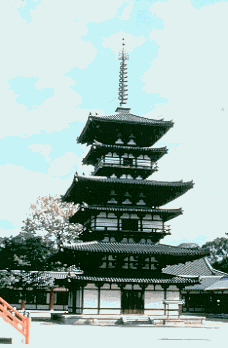
In petition for the recovery of the Empress, Emperor Temmu of Japan established a temple to the Master of Healing in 680.
When the capital was moved to Nara, the Yakushi-Ji temple was also relocated to the capital city in 718.
A ceremony, called Hana-e-shiki, is held in honor of Yakushi every year from March 30th to April 5th at the Yakushi-Ji temple.
The Healing Buddha plays an important role in Buddhism. Through his assistance, the sick are healed, the hungry are fed, and the greedy are made charitable.
Sources
Bell, Gordon. (1998). Healing in Buddhism
Birnbaum, Raoul. The Healing Buddha. Boulder, CO: Shambhala Publications, 1979.
Pasqualoni, Bonnie. (1997). The Medicine Buddha
Robinson, Richard H. & Johnson, Willard L. The Buddhist Religion. (4th ed.). Belmont CA: Wadsworth Publishing Company, 1997.
Yakushi Nyorai , Shingon Buddhist International Institute homepage.