Soto Zen
by Greg Schneider
In attempting to understand the Soto (pronounced "Soh-toh") school of Zen Buddhism, we must first depict the history of this famous sect. Zen Buddhism began during the seventh-century of the Common Era in China where it is known under the Chinese name of Ch’an. In the centuries that followed, Japanese Buddhist monks made pilgrimages to the mainland of China to study with the great Buddhist masters of the times and during these periods, some monks came into contact with Ch’an and returned to Japan to spread its word. However, it did not initially catch hold. As time went by, Buddhism in China became almost exclusively Ch’an and thus when Japanese monks matriculated there, Ch’an was their medium. There were two monks to whom the introduction of Zen Buddhism in Japan is accredited. The first, Myoan Eisai (1141-1215), brought to Japan the ideas of Rinzai Zen. Dogen Kigen (1200-1253) was the second traveler and he returned with and initiated the Soto Zen School, with which this paper is concerned.
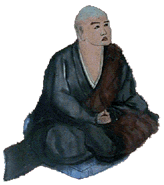
In tracing the history of Soto Zen Buddhism, we can simply trace the story of its founder, Dogen. Dogen introduced the Soto School of Zen after the Heian period and during the Kamakura period in Japanese history. This period lasted from 1185 to 1336 BCE. Dogen first studied Tendai Buddhism at a young age on Mount Hiei. Unhappy with the knowledge that he acquired there, Dogen went to China in 1223. Here he attained enlightenment within the Zen sect of Soto, or Ts’ao-tung as it is known in China. On returning to Japan four years later, Dogen preached the teachings he had acquired in China, specifically the stress of "shikantaza" or more commonly, zazen. Zazen is described as "sitting straight through without entertaining vain thought." This doctrine is the core of Soto Zen today.
At the time when Dogen introduced Soto into Japan, Japan had recently entered into the infamous Mappo period. Described as the period of degeneration of the law, the Mappo period was professed to be a time of non-enlightenment. Dogen did not agree and he dismissed the identification of his generation with the Mappo period. Instead Dogen believed that the attainment of enlightenment could occur at any period in time as long as the proper effort had been given. In this way, Dogen completely denied the efficacy of the "nembutsu", the central method in the attainment of enlightenment for the Pure Land and True Pure Land Buddhist schools. Along with the denial of this doctrine, Dogen also disregarded and refused any attempt to distinguish Soto and Rinzai Buddhism.
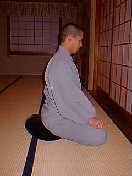
There are few principles in Soto Zen. Mainly, it centers on the practice of meditation or zazen. In propagating the Soto School into Japan, Dogen spent much of his time explaining the correct process of zazen and the reasons for its needed study and practice. In fact, he wrote a famous volume describing the proper techniques and results of zazen entitled "Fukanzazengi" (The Universal Promotion of the Principles of Zazen). He believed that only through the constant practice of meditation one could truly achieve enlightenment. Zazen is a practice where "the body finds itself in that state of relaxed attention in which sense and mind remain awake and yet are released in complete rest." Ultimately, in the case of Soto, it must be understood that enlightenment and the practice of zazen are one and the same.
For Dogen, and the original Soto teaching, the use of koans was not a satisfactory method of attaining enlightenment. Over time, this belief was changed, allowing more koan use; however, this use is not in the usual form of forced koan understanding. It is true that since the Soto School tailored its teaching to each monk personally, the training of particular monks was different; thus, the koan entered at times but it had a different role than usual. Koans were used to extend the student's knowledge of the Buddha's teachings, and provide for him a medium on which to meditate. "Dogen taught that Buddhist training itself was the only true koan, the manifestation of enlightenment."
Along with the above points, the "Encyclopedia of Religion" describes five main religious principles that are attributed to Dogen and the Soto school. The first principle is characterized as the "oneness of practice and attainment". Attainment, satori, is achieved in the practice of zazen, and zazen is satori. The second principle is the primary emphasis on zazen or shikantaza only. The third principle consists in the fact that all beings are Buddha nature.
The fourth principle is that "impermanence is Buddha nature". This means that the Buddha nature is not beyond impermanence, but is impermanence. The final principle is described as Uji or being-time. "For Dogen being and time are completely inseparable. Being is time and time is being." Every particular thing in the universe is itself time.
Soto has now become the main school of Buddhism in Japan. Since its foundation by Dogen, things have been changed. At the outset, the Soto school began to appeal to the Samurai and peasant classes. In order to gain more adherents, Soto assimilated a certain amount of popular beliefs and rituals but devised funeral and memorial services for the dead. Today Soto Zen is becoming more Westernized and many adherents are being found in the United States and other Western nations. Zen is a growing religion and the Soto School and Dogen provide it with major vehicle for this assimilation into Western culture.
Daily Schedule at Zuioji, a Soto Monastery
| Hour | Activity |
|---|---|
| 4:00 a.m. | Bell for rising |
| 4:15 | Abbot’s incense offering in the various halls* |
| 4:20 | Dawn meditation |
| 5:10 | Morning sutra-chanting service |
| 6:00 | Private sutra-chanting for one’s own teachers* |
| 6:00 | Service for Idaten* |
| 6:20 | Morning gruel |
| 7:00 | Cleaning |
| 7:40 | Morning gathering |
| 9:00 | Dharma lecture or scriptural study or manual labor |
| 10:00 | Meditation or manual labor |
| 11:10 | Midday sutra-chanting service |
| 11:30 | Midday meal |
| 12:00 p.m. | Free time |
| 1:10 | Manual labor |
| 4:00 | Seated meditation or continuation of manual labor |
| 4:30 | Evening sutra-chanting service |
| 5:00 | Evening meal |
| 5:30 | Bath |
| 6:30 | Free time |
| 7:30 | Evening meditation |
| 9:00 | Sleep |
1. Kraft, Kenneth, Ed. Zen: Tradition and Transition. New York: Grove Press, 1988. p.157
* Activities performed or attended by a few officers only.
Sources
Dumoulin, Heinrich. A History of Zen Buddhism. Boston: Beacon Press, 1963.
Dumoulin, Heinrich. Zen Enlightenment: Origins and Meaning. New York: Weatherhill, 1976.
Encyclopedia of Religion. Vol. 4. Macmillan Publishing Co., 1995.
Kennett, Roshi Jiyu. Zen is Eternal. California: Dharma Publishing, 1976.
Kraft, Kenneth, Ed. Zen: Tradition and Transition. New York: Grove Press, 1988.
Tsunoda, Ryusaku; de Bary, William Theodore; and Keene, Donald, Eds. Sources of Japanese Tradition. New York: Columbia University Press, 1958.
Yokoi, Yuho. Zen Master Dogen. New York: Weatherhill, 1976.