Shinran
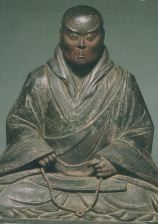
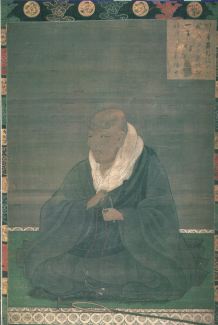
Shinran was one of the most influential figures of his time. He had a very aristocratic childhood, which led to a monastic career. Shinran was born into the Hino family, which is a branch of the Fujiwara clan that dominated Kyoto for two centuries. At the age of nine, Shinran went to the Tendai monastery of Enryakuji on Mount Hiei to begin his life as a monk. The reasons for Shinran’s desire to lead a monastic life are unknown, but some think it could have been due either to the constant warring between the Taira and Minamoto clans, or the loss of his parents at a young age.
Shinran’s induction into monkhood took place under the leadership of the Tendai priest, Jien. The Tendai tradition at that time was dedicated to Esoteric Buddhism, which sought to achieve enlightenment through a complicated regime of mystical meditation practices involving magical diagrams, images, and formulas. Nevertheless, there was also a new stream of thought in those years that emphasized a much simpler approach of pure devotion to the saving grace of Amida Buddha, as well as to the Nembutsu (a catechism of eternal devotion to Amida). These ideas exerted a powerful influence on the young monk. At the age of twenty-nine, Shinran reached an impasse in his life and resorted to a one-hundred-day seclusion at Rokkakudo, a temple dedicated to Avalokitesvara Bodhisattva, in Kyoto. It was here that Shinran was to determine his life’s calling. On the 95th day of his seclusion, Shinran dreamt of Prince Shotoku, builder of the temple and one of the legendary founders of Buddhism in Japan. In the dream, Shotoku told him to seek out Honen, the founder of Jodo (Pure Land) Buddhism, and hear his teachings. The Pure Land approach was totally dedicated to Amida Buddha and affirmed the saving power of his compassionate love. This seemed to offer a new and more favorable path to salvation than the difficult practice of Esoteric Buddhism. In 1201, Shinran abandoned his former life in order to follow Honen.
For six years, Shinran studied under Honen and dedicated himself to Amida Buddha. Both Honen and Shinran had kept their vows of celibacy, diet and strict monastic deportment. After some time, the two began to feel that there was no need to refrain from the ordinary practices and desires of human life, despite the official Buddhist teaching that these were instances of self-indulgence and immoral acts. In fact, Shinran was even more convinced of this point than his teacher. In 1204, Honen issued a pledge, which all of his followers affirmed, explaining the reasoning and justification behind the practice of so-called “self-indulgence” to the officials of Kotukuji in the main Buddhist temple at Nara. This was a bold and risky move. The Kotukuji banned Honen’s Nembutsu teachings in 1207 when two monks under Honen “incurred wrath of the emperor by courting several court ladies.” The two monks were executed. Meanwhile, Honen, Shinran, and six others were banished from Koyoto. Shinran was exiled to Echigo and was forced to return to his secular life. Further, his ordainment under the Tendai practice was officially revoked.
After a few years at Echigo, Shinran married a woman named Eschinni and had six children by her. In 1211, Shinran and Honen were pardoned and Honen returned to the capital, but Shinran did not follow Honen. He remained in the hinterlands, engaged in developing a still more revolutionary path of devotion to Amida Buddha. According to Shinran, even Honen's Pure Land school committed the error of supposing that one could earn salvation through the merit incurred by reciting the Nembutsu. Yet as Shinran insisted, all humans are totally enmired in sin and none are capable of saving themselves. Hence, even repeatedly reciting the blessed Nembutsu was insufficient to achieve rebirth in the Pure Land. For Shinran, there was no difference in principle between saying the Nembutsu a single time with sincerity of heart, and reciting it a thousand or even a million times. Only the utterly undeserved grace coming from Amida Buddha could save us wretched mortals.
During his exile, Shinran founded a new school called Jodo Shin-shu (True Pure Land) and he spent the rest of his life teaching the new doctrine. In 1263, by that time famous and revered as the founder of an important new school of Buddhism, Shinran died.
One important aspect to the life of Shinran was his writings. These writings stemmed from the latter portion of his life and mainly developed the True Pure Land teachings. Shinran’s most famous work, admired by many today, is entitled Teachings, Practice and Realization.
Sources
Bloom, Alfred H. Shinran's Gospel of Pure Grace. Tucson: University of Arizona Press, 1965.
Hiroto, Dennis. The Collected Works of Shinran, vol. 1. Kyoto: Jodo shinshu Hongwanji-ha, 1997.
Sangharakshita. A Survey of Buddhism, 6th ed. London: Tharpa, 1987.
Takeuchi, Yoshinori. The Heart of Buddhism. New York: Crossroad, 1983.