Originally a Chinese game, wei ch'i (its Chinese name) or "go" (its Japanese name) is said to be the oldest surviving board game in the world. Boards have been unearthed that date back to the 3rd century CE and references in ancient records claim the game's origins point as far back as the Shang dynasty, 2000 BCE (Fairbairn Ch. 2). In fact, there are a multitude of myths and legends surrounding the game. The legendary originator of go was the semi-mythical emperor, Yao (ibid.). It is said that Yao invented the game in order to instruct and improve the intelligence of his son (Bozulich Ch. 2). Yao is usually attributed with the creation of go, as well as the calendar and some methods of divination. A number of go authors find here a religious connection between the Go board and divination.
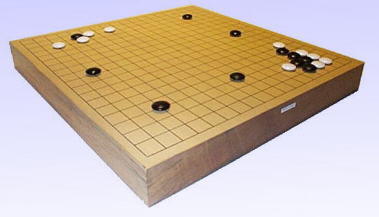
In the early methods of divination, turtle shells and ox shoulder blades were used. The cracks that formed on these bones and shells were interpreted and it was said they could predict the weather and quality of agricultural harvests. As the reasons for divination changed from agricultural prediction to the understanding of the heavens, the method of divination changed as well. There began to be a stronger emphasis on the principles of yin and yang and how they function. A lined board (representing the universe) and black and white stones (representing the principles of yin and yang, respectively) were used to complete the new method of divination.
Certain astronomical symbols were placed on the board and depending on where the stones fell, the prediction or answer was found. In the Yi Zhi (The Essence of Go) by the famous historian Ban Gu (32-92 CE), the divination board is described:
“The board must be square and represents the laws of the earth. The lines must be straight like the divine virtues. There are black and white stones, divided like yin and yang. Their arrangement on the board is like a model of the heavens.”
(quoted in Fairbairn Ch. 2). This description is very similar to that of the current go board.
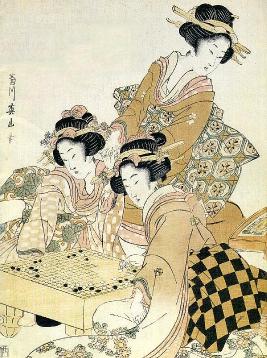
The jump from divination to the game of go is not a difficult one to make; for, as Fairbairn remarks, it is “easy to imagine go evolving from sessions around the board with black and white pieces, conceivably placed in shapes resembling cracks in shells or bones, with priests arguing over possible interpretations” (Ch. 3).
In fact, the terminology surrounding the go board still represents some terms that could be traced back to divination. Richard Bozulich writes in his weekly column in the Japanese newspaper, the Daily Yomiuri:
“The central point of the board is called tengen, ‘axis of heaven,’ and the eight specially marked points near the perimeter are called hoshi, ‘stars,’ the nine together making up the traditional ‘Nine Lights of Heaven.’”
(Bozulich Ch. 2)
The four sections of the go board also contain religious meanings: each derives its name from one of the four basic trigrams of the I Ching (Book of Changes).
“Beginning at the upper right and going clockwise, they are: Southwest (female, earth), Northwest (male, heaven), Northeast (hard, limit), and Southeast (gentle, yielding)” (Bozulich Ch. 2).
Another, quite different version of the origination of the go game is discussed in chapter 22 of Bozulich's column. Here Bozulich provides stories that depict the supernatural associations surrounding the go board.
Below the shallows of the north-flowing Hsun water, and then west, is the so-called “Mountain of the Transcendents' Go Game.” This mountain can be ascended from the west. There is a cavern at its top, and this cavern has screens, chambers and eaves...
The second episode is from a play written in 1715 by the playwright Chikamatsu. This narrative describes a young man, Go Sankei, who in the course of a long walk in the forest notices two old men with shaggy eyebrows and white hair absorbed in a game of go.
Fascinated, Go Sankei muses, “Can this be the pure world of enlightenment?” Carried away with curiosity he cries out. “Old gentlemen, I am interested to see you playing go. Is there some special pleasure to be found in this contest?”
One old man, without seeming to answer, speaks. “If it looks like a go board to you, it is a go board, and for the eye that sees go stones, they are merely go stones...”

These stories help us to realize the religious importance that the Chinese, Korean, and Japanese people place on the game of go.
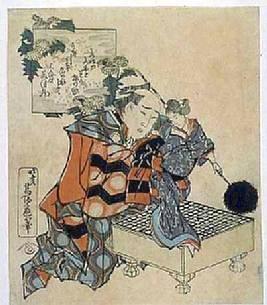
There are also other religious thoughts concerning the game of go. For example, the earliest written reference is found in the Analects of Confucius. These were written in the 5th century BCE.
“It is difficult for a man who always has a full stomach to put his mind to some use. Are there not players of [liu]bo and go? Even playing these games is better than being idle.”
(Analects, Book XVII, 22; quoted in Fairbairn Ch. 4)
Mencius, a disciple of Confucius also mentions the game of go in his books. Centuries later in Japan, Buddhist monks became the greatest players of the age. Nichiren, the founder of Nichiren Buddhism, was reputedly the greatest player of his day.
Over time, the game of go was transported to Korea and then to Japan. There are conflicting accounts of the actual persons who brought the game to Japan and from exactly where.
Go became a favorite pastime during the Heian period and it is described and involved in many scenes throughout the famous Tale of Genji. Soon the game became more mainstream, picking up the interest of the religious and military classes.
This assimilation into the rest of society brought go to the level of the cultural icon that it is today. It remains today mostly a game of the East, but is gradually gaining adherents in Western countries as well.